Provider demand is strong enough to justify building, HREI™ board members say
By John B. Mugford
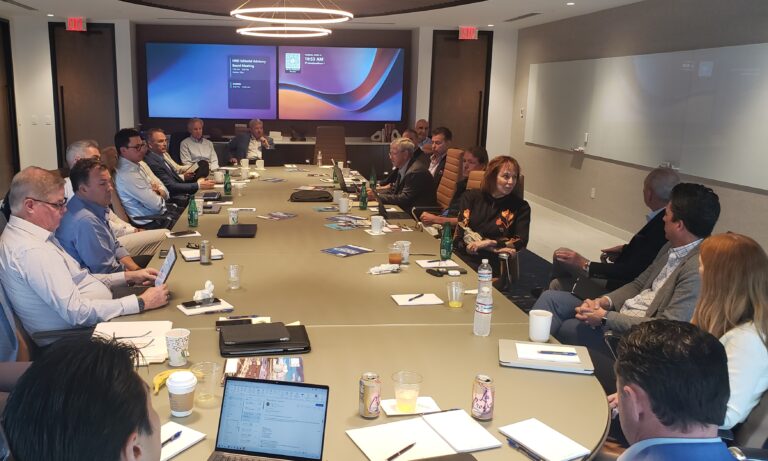
During the recent HREI Editorial Advisory Board meeting in Nashville, Tenn., the board members involved in development explored the seeming paradox of increasing project starts despite construction costs that hit an average of $558 per square foot in 2025. (HREI™ photo)
Medical outpatient building (MOB) construction costs hit an all-time high of $558 per square foot (PSF) last year, yet development activity increased anyway because provider demand has been strong enough to justify the added expense.
That was the consensus of a group of healthcare real estate (HRE) developers and investors who gathered in mid-April for the annual HREI™ Editorial Advisory Board meeting in the boardroom at the headquarters of Healthcare Realty Trust (NYSE: HR) in Nashville, Tenn. HREI and its board were the guests of HR, whose president and CEO, Peter A. Scott, made a guest appearance at the meeting to update the group on the firm’s corporate transformation plan and answer a few questions.
As has been the case at each of the previous 19 annual meetings of the HREI board, the day included an update on the business by Founder and Publisher Murray W. Wolf, as well as an “off-the-record” discussion of the current state of the HRE and MOB space, touching on the political landscape, the state of the nation’s health systems and a range of other topics.
The HREI annual meeting also always includes an “on-the-record” segment during which board members, who represent many of the HRE sector’s top firms across a variety of disciplines, share their opinions and insights on the current market conditions and what might lie ahead. The lengthy discussion covered numerous topics, but this article focuses on the views of those who commented on development.
HREI board members acknowledged that HRE development – although it did indeed pick up a bit in 2025 after a slowdown during the previous two years – remains fraught with challenges and obstacles to growth, including the aforementioned high construction costs, which result in historically high rental rates in new buildings, as well as climbing tenant improvement (TI) price tags.
Yet, Revista, the Arnold, Md.-based HRE data firm that reported last year’s record-high average construction cost, also noted in its recent annual Outpatient Real Estate Development Report that the amount of MOBs started in 2025 was up nearly 18 percent to more than 21.7 million square feet, compared with about 18.4 million square feet in 2024 and about 19.9 million square feet in 2023.
During the HREI meeting, board members explored this seeming paradox of increasing development activity despite record construction costs.
‘We’re starting to see more projects now’
“It is looking like there are getting to be some more opportunities in terms of development, as evidenced by the latest Revista numbers, which show that development is ticking up a little bit,” said Jonathan L. “John” Winer, president and chief investment officer with White Plains, N.Y.-based Rethink Healthcare Real Estate, which both acquires existing outpatient facilities and serves as a capital partner for new developments.
“Last year represented a low point in (new project) deliveries,” he continued, noting that the amount of medical outpatient building (MOB) square footage started nationwide represented about just 1 percent of current inventory, compared to the historic average of between 2 and 3 percent.
“But, we’re starting to see more projects started now, which is good news for developers. But, currently, in terms of market opportunity, because there has been so little development, development yields have really been beaten up somewhat and so we – even though we back developers – we’re finding, quite frankly, a better return, better risk-adjusted returns on the acquisition side of the business than on the development side.”
Development yields, the return a developer earns relative to total project cost, have compressed as construction costs have risen faster than achievable rents, making new projects harder to pencil, Mr. Winer said.
“But, even so, we’re keeping a close eye on development opportunities, and we will always want to be in the development business and to be working closely with good, quality developers.”
A ‘build it anyway’ mindset
Although development has slowed in recent years, HREI board members noted that health systems are still seeing the need to expand their footprints, often through new MOBs in growing markets where they would like to get a leg up on competitors.
“Development is slow,” acknowledged Richard M. Rendina, chairman and CEO of longtime HRE development firm Rendina Healthcare Real Estate, which is based in Jupiter, Fla. “There’s still sticker shock over the cost of construction, the cost of tenant improvement buildouts, and there is still … uncertainty in interest rates and kind of global markets, if you will, with tariffs causing uncertainty and a little bit of paralysis, maybe for some of the health systems.
“But I will add that cost is not as big of an issue for the large health systems that are well capitalized, but it is in terms of how much they can do. We’re always looking for avenues to help health systems leverage their balance sheet by aligning with the developer, and why not do four MOB projects for the price of doing one, as far as their cost of capital goes? Because of this, for us, the fee-for-service side of the business has been great.”
Deenie Taylor, chairman and CEO of Milwaukee-based Landmark Healthcare Facilities, said, “The hospital systems we’re talking to and working with have a desire and need to go into new markets in order to compete with other health systems, and that is driving the development of outpatient medical buildings.”
Mr. Taylor noted that most of the firm’s development work is coming from health systems, as higher rents in new buildings are effectively shutting out independent physicians as tenants.
“I just don’t see independent physicians being able to afford new space at the new at the higher rents,” he said. “You know, I still remember when you put a building up, you talked $20 per square foot or so for rents. Now, we’re talking the high $30s, low $40s, triple net… and, today, it seems that all the physicians are employed, and that’s just across the board. So, that trend has gone substantially to the majority.”
Although Mr. Taylor said Landmark is not seeing many opportunities to develop larger MOBs – those in the 150,000 to 200,000 square foot range – the facilities the firm is developing tend to be far more complex.
“What we’re looking at are all in that 60,000 square foot kind of range,” he said. “But, the acuity in these buildings is over the top with what the providers are looking to do in terms of catheterization labs in an ambulatory surgery center (ASC).”
A growing number of health systems that Landmark is working with, he added, are interested in “creative ownership models” with the developer, and “we are modifying” the firm’s once prevalent “no-cost ownership model” that Landmark’s founder, Joe Checota, so often used in past decades.
Mr. Taylor added that “TIs are where the expenses are really high, as, I mean, we’re beating up on general contractors to manage our core and shell, but the inside is where the expense really is. And if you’re at $100, or $150 dollar TIs (PSF), the hospital’s coming out of pocket for that. I keep telling them, put that money toward the overage. As you don’t want to put that capital in the building with us. It doesn’t make sense. Lower your rent so that we can do it that way.”
Tenants will need to accept higher rents
John Pollock, chief financial officer and managing director with Walnut Creek, Calif.-based Meridian, which often acquires HRE properties and upgrades them, or converts other facility types to medical, said the firm had a “good 2025, below plan, like the past few years, as it was development only for us.
“I’m really encouraged by what I’ve heard around the table today about increased liquidity coming into our space, as that has been a challenge the last couple of years for us,” he said.
“I do think that in our development activity, both the costs, which are moderating but are still much higher than historically, coupled with rising interest rates, have made it challenging to get yields for some of the new development projects.
“But, I would agree that there is definitely a pent-up demand that I think will lead us to a lot more work here in 2026. We’ve had some success doing conversions, with tenants in tow, you know. So I do think we’ll see more of that, which is a great way to mitigate some of the increased costs and also helps a lot with speed to market. We’ve done that successfully several times.”
He added that tenants in HRE facilities, as many on the EAB noted, are going to have to accept higher rents, “because projects just don’t pencil the way they used to. And, you know, if and when some of them come to terms with that, that will help to break the logjam of delayed projects.”
Ben Ryan, partner and CFO with longtime HRE development firm PMB LLC, which is based in San Diego, said the firm is quite busy, noting that when it competes for projects through a request for proposals (RFP) process, it’s noticed that the spreads are “tight, relative to the development yield that you have to bid to win the deal versus what the exit caps are today.
“And, the projects we’ve done over the last three years, and what we’re going to do in 2026, are so much larger than they were six or seven years ago. So, we’ve got a $150 million development we’re working on with a 30-month construction period, and you know the SOFR (Secured Overnight Financing Rate) … makes it hard for us to beat the IRRs (internal rates of return)…
“On the other side, the fee revenue is much, much higher than it ever was, because the project itself is so much higher, and we’re just looking at different ways to execute these things so we can actually make a profit, and one of those is through a 501c3 lease revenue-bonds structure, which essentially converts us to a fee that we can put at risk.”
Construction costs have at least ‘stabilized’
Devereaux “Dev” Gregg, executive VP of development with Charlotte, N.C.-based Flagship Healthcare Properties, said the firm has its strongest pipeline of projects over the next 12 months that it’s had in the last decade.
“Why is that?” Mr. Gregg asked, rhetorically. “A lot of it is just the delays in projects in the existing pipeline, and they are finally coming together.
“I also think that construction costs, which were such a problem three to four years ago, have at least stabilized – and it’s the second year in a row that they’ve somewhat stabilized – they’re not going down, but they’re at least somewhat stabilized.”
He added that when Flagship talks to its clients and tenants, especially health systems, and perhaps some of the larger private physicians groups, “they understand that if you build a new building with a decent TI, rents are going to be in the mid- to high-$30s. That was a hard sell when we had to get from $30 to $35, but these days, if you project out, they understand that, and I think they’re more accepting of that.”
In terms of Flagship’s pipeline, the firm is seeing an increase in fee-for-service development work, as well as “core, 100 percent-filled projects … even though we don’t have a problem taking on some speculative risk, as we’ve started a couple projects recently in the 50 percent pre-leased range, but those projects are … in the 30,000, 40,000 to 50,000 square foot range. So there’s not as much spec leasing.”
Mr. Gregg also noted that the firm’s investment in new relationships and land acquisitions are “starting to pay off after three or four years,” getting to the point where we can “start on those projects. We’re not necessarily a land speculator, but it’s nice to see those bets kind of paying off.”
Developers must prove their worth
In this era of high construction costs, HRE development firms need to show their clients, even health systems, that they can not only provide development and project expertise, but that they can provide value and, in many cases, cost savings.
Greg Venn, CEO and Co-Founder of Denver-based NexCore Group LLC, said the firm has “found a way to differentiate ourselves by focusing on speed to market, and, as we often say, there’s a certain inflation that’s involved in a lot of these projects when hospitals develop them.
“If you, as a private developer, can show there’s value creation by being able to go in and approach the design and construction of a medical office building differently than if as the hospital develops it, that you can prove that not only did you make enough money to support the fees but also to support the cost of the capital you’re bringing in, then you can prove your worth to them.
“Because, there are often times when you can come in at 20 percent to 30 percent less than if the hospital had done it the traditional way of self-developing it. There’s still a … focus for us on value creation in this business, and it matters.”
Philip J. “PJ” Camp, a long-standing HRE professional who retired in 2024 as managing director and head of healthcare real estate investment banking with New York-based Fifth Third Securities, agreed with Mr. Venn that HRE development firms need to demonstrate their value to potential health system clients.
“From a developer’s perspective,” said Mr. Camp, who worked closely with numerous health systems on various endeavors, including real estate development, “I think the hospital systems have either, rightly or wrongly, viewed developers as a commodity service. And I think that that’s a spot that developers have to get out of, as you have to be able to prove your value-add.
“Maybe you do so through thought leadership. Maybe it’s through owning the ground that they want to build on so they can’t build on it and they need you and you can set the rules. Maybe it’s through being able to control costs of construction through different means, maybe it’s by doing a prefab project, or panelized systems, or whatever you can do to bring value to a project that … they don’t think they could do on their own. I think that’s the challenge for developers.
“Also, if you have a specialty in rehab hospitals or something like that, and you can show the system that you can do that type of project better than anybody else, I think that’s also probably a winning formula.”
Finding ways to overcome project delays
James A. Schmid III, managing partner and chief investment officer with Charlottesville, Va.-based Anchor Healthcare Properties, said one of the keys to the firm’s success in recent years, especially in 2025, was its diversification of revenue.
“Our business is a good demonstration of why diversity of revenue is a real benefit and a differentiating factor,” he said. “Projects get delayed, acquisitions get delayed. Timing is one thing in this business that all of us have to unfortunately suffer through.
“As we’re trying to incubate projects out of the ground, working with health systems and similar clients, the reality is that these projects can take more time than we’d like for them to get started, and to, obviously, start generating fees accordingly.
“So, having a base of assets to be able to generate revenue from, be it from management, be it from leasing, be it from construction management, and from all of the above, is exceedingly helpful, and certainly in 2025 that was a major benefit to our business and helped offset some project delays.”
“We’ve worked hard to create that differentiation, and, as I mentioned earlier, we also have a new business unit that focuses on off-balance-sheet financing, structured finances as we call it, all soon to be tax-exempt bonds as well. Again, these are complementary elements of what we do, and these are some of the things we’re doing that provide benefits to the health system clients that we work with.”
As Anchor provides services to its clients, Mr. Schmid noted that “we’re seeing more and more demand for specialty healthcare facilities, be they inpatient rehabilitation hospitals, freestanding emergency departments (FSEDs) that are sponsored by health systems, behavioral health facilities, which … I think in years to come we’ll be talking more and more about those.
“I think health systems see a continued need for dedicated purpose-built facilities to address that patient population, and sometimes they’re pairing them up with other elements of the traditional facilities that we have developed. So, I think that’ll become increasingly important.”
A good pipeline, but taxes are high in Minnesota
Mark Davis, principal and founder of Minneapolis-based Davis Healthcare Real Estate Services, said the firm saw a steady stream of development business in 2025, in part because of “a couple of delayed starts, a little slower than we anticipated.
“But, we currently have four or five development starts lined up for 2026, with two of them already under construction. So, we’re optimistic about the year ahead, as large specialty groups are really the drivers for most of our development projects and we’re finding that most of them have gotten over the idea that they’ll have to pay rents in the mid-$30-plus range in order for them to achieve their expansion plans.
“So, we’re really seeing, at least in Minnesota where we do most of our development business, being able to bridge that just because they’ve had this the strategy for growth and they have to pay that rate to make that work. Most of our developments are with our existing client base, so we don’t compete. A lot of times we also take lease-up risk on almost every deal, and so we get to market quicker with the confidence that we can do that, and thankfully we’ve been able to achieve that.”
Davis, he said, has its own architectural group, “and so we use that as a loss leader. We’ll go in and we’ll do the building plan, the site plan, and the space plan on an opportunistic basis, where most developers wouldn’t take that risk. In some ways, it’s maybe not the smartest thing for us to do, but I feel we’re already paying the cost of our five-person architectural team to do that. So, it allows us to use that to advance our deals.”
While the pipeline is strong for Davis, Mr. Davis noted that what “burns a hole for us every day is that the real estate taxes in Minnesota are absolutely crazy. We average $8 to $12 a foot in real estate taxes alone, so most of our ‘Class A’ products have operating costs of between $20 and $25 dollars per square foot. Most markets don’t have to worry about $10 to $12 of real estate tax, as they might be in the $3 to $4 to $5 range per foot.”
He added that this “puts a lot of pressure on trying to get deals done, especially to get deals done on the renewal basis to retain tenants. We continue to push on that, and we’ve gone from a strategy of not wanting to rock the boat to challenging taxes on every building, every year, and we have been successful in starting to start seeing some benefit of going after that on a continued basis.”
Mixed-use is a good place for medical
Sharon Harper, CEO of long-time HRE development firm the Plaza Companies, based in Peoria, Ariz., said the firm is finding plenty of opportunities to develop medical projects, including outpatient, research and other types of facilities, in larger, perhaps redeveloped mixed-use developments.
“We’ve really moved into a place where we’ve been able to combine public-private university partnerships for the growth and the good of our region, and that has definitely involved healthcare, a bit of bioscience, and then more broadly in mixed-use development,” she told the EAB. “Over the years, we’ve grown increasingly involved with transforming large shopping malls into mixed-use communities and, within those, there is always a place for healthcare.”
She said the firm has played a major role in redeveloping and rebranding the former Park Central Mall in Phoenix, which was the area’s first shopping, into the Phoenix Medical Quarter, which she said included “so much in the way of healthcare and bioscience, from the state-funded Wear Tech startup to medical education,” as Omaha-based Creighton University opened its seven-story, 196,000 square foot academic health sciences facility in the project in 2021.
“We also have three nursing schools in this development, and space that’s home to (Chicago-based) CommonSpirit, as their part of the umbrella. Barrow Neurological Institute will have a big institutional research center there as well. And, the development has 14 bars and restaurants and all this mixed-use that are part of that.
“I think that in the remainder of 2026 and beyond, we will grow both in mixed-use and healthcare, what with relationships that we have or around healthcare, whether it’s academia, hospitality or other kinds of services that work well together.”
Malcolm Sina, executive chairman and founder of Palm Beach Gardens, Fla.-based Sina Companies LLC, also said that the longstanding development firm has found success in adding medical facilities to mixed-use developments.
He noted that the firm predominantly focuses on development, including fee development projects, because “the amount of capital that’s available in the marketplace, especially on the acquisitions side, makes it tough to compete against most of you in this room.”
He noted that while it’s also difficult to compete for HRE development projects, “I’m on the board of a couple other companies that do not focus on healthcare, and, well, all of us in this room should continue to feel blessed that our product type is one of the favored food groups, and that is even versus multifamily, which is suffering in other parts of the country. Self-storage is seeing the same thing, and office, as we all know, hasn’t even suffered the worst part of its demise.
“The vast majority of what we do is repeat and referral business, being in the business as long as we have, over three decades. A lot of what we do is to try and be part of mixed-use developments. That may range anywhere from 5 acres to 2,000 acres. On the smaller size mixed-use developments, we will own and control it ourselves. The larger it gets, (the more) we will be the healthcare portion of that development.”
Some of the projects Sina is working on include the development of two MOBs next to a neighborhood micro hospital in Florida.
On that project, “like some of the other people in this room have said, we will be taking on leasing risk, probably starting with 50 percent pre-leasing, and based upon the lender relationship that we have they’ll feel comfortable with this going forward on that basis.
The firm is also working on projects that will include inpatient rehabilitation facilities (IRFs), behavioral health facilities, multi-tenant MOBs and workforce housing.
“We’re working on one site that’s right next to a new hospital being constructed and we’re looking at workforce housing there, in combination with some of these other product types that I had mentioned.
Other thoughts on development
Thomas W. “Tommy” Tift III, a longtime HRE professional based in Atlanta who serves as an executive VP with Dallas-based Lincoln Property Co., said there is growing competition in the HRE development space because many professionals involved in the office sector are looking to get involved in MOBs and HRE facilities.
“The office market is in the tank, and a lot of those guys have viewed it as, ‘well, we’re office guys, so we can do medical office,’ and that’s created a lot more competition,” he said.
“There’s a project in Atlanta right now that just got foreclosed on recently – it’s 15 buildings and it’s in the middle of Buckhead – and four of those buildings are being totally converted to medical office (by Boca Raton, Fla.-based CP Group). I think it’s going to be pretty successful.”
“On the development side, we’re looking at four to five projects in the Atlanta metro area, and just like everybody else has been saying, it’s tough to get the rents. The only people that can seem to pay the rents are the health systems, or some of the large physician practices, such as surgeons, orthopedics, groups like that.
“But even so, we’re all in medical office, and it’s still the best asset class in real estate right now.”
Michael Bennett, managing partner with Minneapolis-based MedCraft, said he believes the sector will see more office-to-MOB conversion projects, or at least attempts to do such projects, even though not all office buildings make good candidates for such conversions.
“Almost every capital group that we talk to asks us about converting office to medical, and we say, ‘Well, that’s the antithesis of really what medical is all about.’ You can’t take a building, amenitize it, put new landscaping in, change the carpet, and then hire a new leasing agent, give them free rent and see new medical tenants come from down the street. It just doesn’t work like that.”
Mr. Bennett added, “That’s why we like medical, because of the stickiness of the tenant.
“But, I do think that the cost factor of a conversion, if it’s done right, can potentially provide a hospital system a cheaper option, and maybe it’s a faster option and maybe we will see some episodic success in that… It’s probably not going to be successful in markets where there are other options for the sponsor to do something other than just medical. I think they’ll try that first, and they’ll have a little backup plan.
“But, I do think we’ll see some more visibility with that, and we’ll all see how those outcomes work out.”
New development should be on the rise
As he finished up his thoughts on the HRE and MOB development market, Mr. Camp said he believes there will be an increase in new projects on the horizon.
“We’ve got the Silver Tsunami finally hitting, as we’ve been talking about this for decades and it is finally coming to fruition,” Mr. Camp said.
“I believe in new developments at this time, because there have not been a lot of new projects being developed, and when there are new projects, those are the buildings that get all the move-ins.
“Nobody wants to move into the old spaces. They all want to go to the new place. So, I am a fan of new development right now, and if you can find the capital, that’s the hard part, the debt capital has been very, very hard to find, but it’s beginning to become more available now (and) you can make new projects work.
“Because of this, I think we’re going to be seeing more new development.”
The full content of this article is only available to paid subscribers. If you are an active subscriber, please log in. To subscribe, please click here: SUBSCRIBE