




Cushman & Wakefield webinar explains why more investors are turning to MOBs
By John B. Mugford
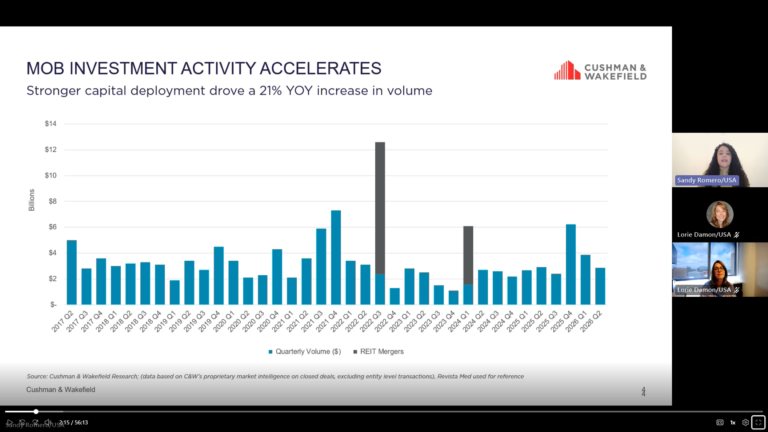
Steady income and recovering values are two primary reasons why investors are increasingly turning to medical outpatient buildings and other healthcare real estate, according to comments during Cushman & Wakefield’s recent Vital Signs webcast. (Slide courtesy of Cushman & Wakefield)
It is quite clear that investor demand for medical outpatient buildings (MOBs) is holding steady, and perhaps increasing, despite some macroeconomic concerns amid ongoing geopolitical uncertainty.
Digging deeper into that dynamic, last week’s Vital Signs webcast, hosted by a variety of teams with Cushman & Wakefield (NYSE: CWK), provided data showing why investors – including those involved in a variety of alternative asset classes – are increasingly turning to MOBs and other healthcare real estate (HRE).
Sandy Romero, head of Cushman & Wakefield’s Office and Alternatives Insights, told the audience that – in addition to an aging population, rising healthcare spending and a continued migration of care to outpatient sites – the “combination of steady income plus recovering values is what’s driving investor confidence in the (MOB) space.”
Ms. Romero pointed to Cushman & Wakefield data indicating that total returns for MOBs “have consistently outperformed over the long term, outpacing both the National Council of Real Estate Investment Fiduciaries (NCREIF) all-property
index and related sectors, such as life sciences and senior housing-assisted living.”
That data shows that, as of the first quarter (Q1) 2026, one-year total returns for MOBs reached 6 percent, exceeding the NCREIF all-property index, which stood at 4.9 percent.
A slide she presented also showed that “strong income performance has been the primary driver of healthy total returns,” with “MOB income returns consistently (averaging above) 5 percent annually over the last decade, outpacing the all-property index and most property subtypes, while providing a durable hedge through periods of market volatility.”
Although appreciation for MOBs has been more “cyclical,” with three years of negative returns from 2022-24, MOB appreciation has been positive since 2025, according to Cushman data, which is “reinforcing overall total return strength,” according to the firm.
“Looking ahead, continued income durability and improving appreciation trends are expected to push MOB total returns higher in the near term.”
Ms. Romero was one of six professionals from Cushman & Wakefield taking part in the Sept. 23 Vital Signs webinar. The others were Lorie Damon, executive managing director, Healthcare Advisory Practice; Travis Ives, executive director and co-head of Healthcare Capital Markets; Sheila Bale, managing director of Agency Leasing & Strategic Advisory; Lindsey Groom, managing director, tenant representation and strategic advisory; and Tyler Morss, director of Healthcare Capital Markets, Equity, Debt & Structured Finance.
The webinar provided a range of statistics that reinforced the strength of and demand for the MOB product type, including the following:
The full content of this article is only available to paid subscribers. If you are an active subscriber, please log in. To subscribe, please click here: SUBSCRIBE
