




The sector continues to perform amid wider concerns, InterFace panel says
By John B. Mugford
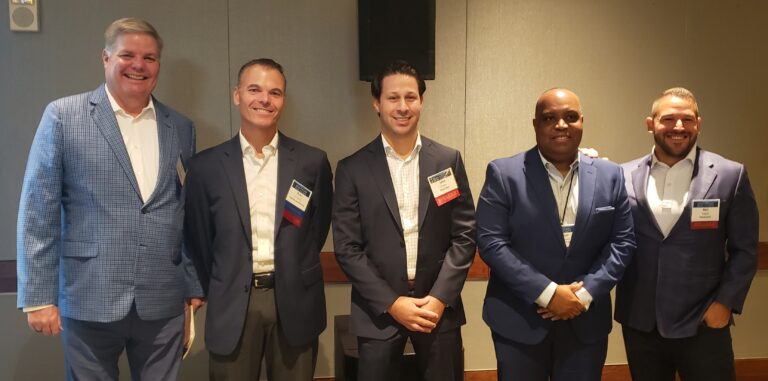
The ‘State of the Industry’ panel at the Sept. 16-17 InterFace Healthcare Real Estate conference in Dallas included (from left to right); moderator Andy Dow of Winstead PC, Ryan Crowley of Healthcare Realty Trust, Jake Broser of Blue Owl Capital Inc., Mervyn Alphonso of Anchor Health Properties and Ben Appel of Newmark Group Inc.’s U.S. Healthcare Capital Markets team. (HREI™ photo)
In summing up the state of the healthcare real estate (HRE) market, Andy Dow, an HRE-focused attorney, said, while moderating a panel of sector professionals: “At a time when there seems to be pessimism in some aspects of the macro economy, the healthcare real estate sector is seeing optimism.”
Mr. Dow, co-chair of the Real Estate Industry Group with Dallas-based Winstead PC, was relaying the thoughts conveyed by one of the panelists, Ben Appel, vice chairman and co-head of the U.S. Healthcare Capital Markets team with Newmark Group Inc. (NYSE: NMRK), during a pre-panel preparatory call before last week’s 17th Annual InterFace Healthcare Real Estate Conference at the Westin Galleria in Dallas.
“The general comment I made about macro pessimism and sector optimism speaks to relative raw uncertainty, whether that’s geopolitical or otherwise,” Mr. Appel said. “Around the world, there is uncertainty in a lot of different ways that I think is coming together in a focus on U.S. commercial real estate, which, globally, investors are underallocated to, and when you think about risk … where you can put your money … you put it into safe spaces.”
He also added: “When you look at how (investment) portfolios are balanced today, it sort of paints the picture to suggest that medical office and healthcare real estate, in particular, is a really good place to deploy capital today.”
Messrs. Dow and Appel were part of the InterFace panel session titled, “State of the Industry Report.” The other panelists were:
■ Mervyn Alphonso, partner and executive VP of development and acquisitions with Charlottesville, Va.-based Anchor Health Properties;
■ Jake Broser, principal with New York-based Blue Owl Capital Inc. (NYSE: OWL), which in recent months acquired Tampa, Fla.-based Sila Realty Trust Inc. (NYSE: SILA); and
■ Ryan Crowley, executive VP and chief investment officer with Nashville, Tenn.-based Healthcare Realty Trust (NYSE: HR).
While delving into the state of various aspects and product types of the HRE sector, the panel session was built upon Mr. Appel’s theme of “macro pessimism” during a time of HRE “sector optimism.”
Prior to the panel, Hilda Martin, a principal with the HRE data firm Revista and its RevistaMed service, which compiles a wide variety of sector data for its subscribers, presented a snapshot of current HRE data.
As part of her presentation, Ms. Martin showed that the demand for medical outpatient buildings (MOBs) is strong, as the sale volume totaled $6.5 billion in the first half of 2026, a 71 percent increase over the first-half 2025 volume of $3.8 billion.
Her slides of RevistaMed data also showed that the MOB occupancy rate remained near a record-level of 92.3 percent, with MOB space absorption remaining high in most of the country’s largest markets.
“We haven’t finished the third quarter yet, but the sales volume is already above the second quarter (of $2.5 billion),” she told the audience. “The fundamentals are strong. We have all of those tailwinds in the sector.” Ms. Martin did note, however, that MOB construction starts, “while they started to pick up last year, have slowed again this year in 2026,” which is driving pricing and occupancies higher for existing facilities.
Moving on from the ‘fixed income-plus’ stigma
Following up on Mr. Appel’s assessment of the sector, Mr. Crowley of Healthcare Realty said that he thinks it is perhaps time for the HRE sector to move beyond its long-held stature as a “fixed income-plus” type of investment.
“We think that this is the time for this industry to break out of that fixed income-plus stigma, and that’s how you get better multiples. That’s how you get lower cap rates when you can prove that the strengths and the tailwinds on the supply-demand side are leading to outperformance at the property level, and everybody wins.”
Mr. Crowley said that “top tier, high-quality medical office assets have such durable and predictable income streams that it’s almost a bond-like sort of property and asset class…
“And so, what does that mean in a higher rate environment? It means that we, as operators, owners and investors, need to really lean into the macro environment that Hilda did such a great job setting up, noting that the new supply (of MOBs) coming online from construction has never been lower, with it currently being at less than 1 percent of existing inventory.
“Occupancy has practically never been higher than it is now, at 93 percent, and rent growth is still (increasing), right? So, it behooves us to lean into the supply-demand dynamic. That is a massive tailwind.”
Mr. Broser of Blue Owl said that “piggybacking off of what Ryan (Crowley) said, we view it in a similar way. We think the market, and the asset class, has a ton of durable cash flow, right? As we go into this kind of environment, it’s defensive, it’s non-discretionary, good supply-demand fundamentals, as Ryan outlined, mission-critical assets, heavy investment, high switching costs.
“Those are all drivers for us that got us excited about coming in,” Mr. Broser continued. “Of course there are the macro tailwinds as well: an aging population, broader healthcare spending, so on and so forth…
“We’re not only focused on real estate. We’re not only focused on the supply-demand value benefits. But we spend a lot of time underwriting tenant credit, operator, payer mix, asset-level coverage, and affiliates. We spend just as much time underwriting that as we do with the … real estate, because our view on cash flow predictability really comes down to the underlying tenant, the lease structure, the lease duration. So, in this environment, we think healthcare is a great place to be for that protection.”
With HRE development remaining in a multi-year slowdown, Mr. Dow asked Mr. Alphonso of Anchor Health Properties how the firm, which develops facilities as well as acquires and manages them, is currently looking at the development of new facilities.
“Is there anything out there that’s changing you the way you are thinking about new development?” Mr. Dow asked. “And, what do you see from an overall development perspective?”
Mr. Alphonso responded that the overall costs of developing projects, including labor and materials, is still hindering new construction.
He pointed to a project that Anchor is in the process of completing soon, noting that “when we started that project, we felt pretty good about the budget, and in talking to our general contractor we had did anticipated that of all things, the plumbing costs would come in much higher than anticipated … and that’s because in certain markets at a given time, you have pressures and labor costs related to other competing projects, and I don’t mean just healthcare projects but all projects in general projects. There was a shortage of plumbers in that market at that time.
“So, we had to readjust scope of the project and the budget, and it was a meaningful impact, I can tell you that.”
The firm then had to “discuss that, of course, with the with the health system… Even in this era of tariffs, where we see fluctuations in material costs, we can accommodate those. We can take on strategies to lock in costs on steel, or glass, or other materials. But, the cost of labor is one thing that’s really challenging for any developer to try to control, and we have to kind of mitigate those the best we can.”
Why REITs are divesting out of the sector
Mr. Dow said at one point during the discussion that he wanted to “pivot to another really interesting topic … and that is the disconnect between the public and private valuations.”
He asked Mr. Crowley to explain “what we mean by that.”
Mr. Crowley responded that the sector has seen a few large, publicly traded real estate investment trusts (REITs) sell substantial amounts of MOBs and reinvest the proceeds into seniors housing.
“That’s because the public markets are putting a tremendous premium in the public markets on seniors housing, and they have a tremendous discount on the outpatient medical sector,” Mr. Crowley said. “So, we’re the only (pure play) medical outpatient REIT that exists. That’s all we do. It’s all we own.
“And today, if you were to look at the share price that we’re trading at, and then you compare that to what is the actual asset value of all of our 565 buildings, it’s about a 20 percent discount. So, there’s a disconnect, right?
“So, for us, to address that, we’re not going to issue equity to buy buildings; that would be dilutive. Our balance sheet is really tight, clean, and we’re not going to change that by taking on debt. But one of the things we can do is lean into that disconnect by strategically selling assets at private market-bearing cap rates in the high (5 percent) to mid-6s, and use that capital to buy back shares, where in the public markets they are valued at an implied (7.5 percent to 8 percent)-plus cap rate, and that quotation is really accretive to us. We’re not the only ones doing it, right? And, I’m going to hand this one off to Jake (Broser), because it was a perfect example of a smaller public REIT … seeing the opportunity on the private capital side to recognize shareholder value.”
Mr. Broser added, “that’s exactly right, and when we looked a Sila, we did an in-depth … analysis, and what we found was our view of spot valuations on an asset-by-asset basis was worth a lot more than where the business was trading in the public markets. So, even if we applied a premium to buy the business, we were able to acquire Sila and what we felt was an attractive discount to NAV (net asset value).
“This was a business that was scaled, diversified, long duration leases, high occupancy, good … coverages, going back to my comments earlier about predictable cash flows, and we were able to buy that at dislocated pricing at an attractive entry point. So, for us, it was a really strong investment.”
Mr. Crowley noted that as Healthcare Realty looks to grow through acquisitions, it cannot do so by issuing “equity, and we don’t want to issue new debt. So, how can a public (REIT) do so when retrading at a material discount to NAV?
“Well, one thing we did was create a new joint venture with KKR (&Co., NYSE: KKR), which is a tremendously attractive cost of equity for us, and it’s through a public REIT partnering with high-quality, low-cost institutional equity partners like them that allows us to deploy capital alongside them and grow.
“We’ve pivoted that towards acquisitions deliberately and modestly this year, as year-to-date we’ve closed contractor LOI (letters of intent) of $400 million of acquisitions. By partnering with private capital, which sees the attractiveness of our investment team, they see the attractiveness of our asset management operating platform. We can get fee-enhanced returns that look really attractive relative to just going in on a loan, from the capital perspective.”
More portfolios on the market
In introducing a new topic, that of the increased number of MOB portfolio sales taking place, as well as an increase in the number of portfolios for sale, Mr. Dow said: “(The panelists) have said there are possibly eight to 10 large portfolios in the sale market. Why is that?”
Mr. Appel said one of the reasons is because “there’s a lot of new capital entering the market, and that capital entering the market wants scale. They don’t like the ones and twos, they want big scale. But, there are other factors as well that are creating this significant increase in portfolios that we’re seeing.”
He added that the supply of several of those large portfolios in the last couple of years have come by way of publicly traded REITs.
“If you looked 15 years ago at the medical office market as a whole, where it was, who owned most of the facilities, and who the participants were, it was largely the REITs and the health systems,” Mr. Appel said. “The markets evolved very substantially, but still, even in the last few years, REITs have tended to own a pretty significant portion.”
But in the last year or more, the “public REITs, sort of driven by the street, have said, “Get out or reconstitute, restructure, recapitalize. Do something with your medical office portfolios. You know, and folks are getting rewarded for seniors housing, for example. Others are looking at life science or other alternatives, but it’s a shift.
“Ultimately, that shift will likely come back around, and we’ll see another wave of volume in in coming years that shifts everything back. But right now, when you see these $1 billion to $2 billion … or even $3 billion transactions, there’s also going to be a downstream transaction volume that occurs as a result. Large pools, individual asset sales … there’s a whole downstream component of that first transaction that really accelerates velocity.”
Mr. Crowley of Healthcare Realty reiterated that the senior housing market, especially when it comes to acquisitions, is experiencing “explosive growth.
“That’s why Welltower (NYSE: WELL) trades at like a 3.5 percent refined cap (capitalization) rate, which is just astounding. We (HR) trade at a 7 percent to 8 percent refined cap rate, which is also astounding in the other direction. And it comes back to why, right?
“And, as noted earlier, it’s because this is fixed income-plus. But, it should be better than that. And, it’s interesting that on the private side, whether it’s life companies, insurance companies, institutional net-lease investors, they like that profile. But the public markets right now are more focused on growth, and usually it’s almost the other way around, which is kind of interesting.
“I think that the supply-demand and backdrop, the demographic backdrop, the provider and provision of care shifting from inpatient to outpatient is so strong that we need to lean into the fixed income-plus when we create an asset class that is transforming from a 2 percent to 3 percent NOI (net operating income) growth model to a 4 percent to 6 percent annual NOI growth model. That’s when capital is going to flow back into MOBs.”
When asked about Anchor Health Properties’ strategies for acquiring HRE assets, Mr. Alphonso said that the firm has grown its portfolio substantially during the past decade by focusing on $10 million to $20 million purchases.
“We’ve also targeted assets in markets that we like, where we can grow our scale, and that’s how we’ve really grown our platform in the last 10 years,” he said. “We will continue to do so, continue to look at those opportunities. Also, the capital that we have aligned with backs us on that strategy.
“So, capital-wise, we I think we’re in great shape. We continue to diversify capital. We have multiple capital partners, many in this room may know, and that gives us the ability to not only be geographically diverse, but to also be diverse about what we actually pursue.”
Health systems are doing well; buying MOBs
Near the end of the discussion, the talk turned to the health systems and their collective financial health.
Mr. Dow noted that many of the “health systems are actually pretty flush with cash, and it’s for it’s for two reasons: they have been doing well on operating margin, and what people don’t realize is … that over 60 percent of all hospitals are part of private, not-for-profit health systems, and they are mission-driven, predominantly religious-affiliated…; and, the big buttress to health system balance sheets has been really strong investment performance. I’ll use Ascension Health as an example … they have a $18 billion cash and investment portfolio. They made a 10 percent return on that last year, which means half of that $1.8 billion worth of cash is outside of operations.
“So, they’re thinking, what is the best use of that cash? It’s a capital allocation decision, and one of the decisions they’re coming to is, I’m going to buy back MOBs that are particularly core to my mission. For them … the cost to replace those facilities is well above the cost of buying.
“For us, when we see that dynamic, if a hospital wants to engage with us in buying back an MOB that we also view as core, I have to compare what they’re willing to pay, what the private market is willing to pay, and what the public markets are valuing the assets at.
Mr. Dow noted that if a “major health system is interested in paying a market clearing 5.5 percent to 6 percent cap rate range, and I’m comparing that to my public cost of equity, which is much higher than that, the system is going to lean into that from a capital allocation perspective. It would almost be irresponsible not to, right? And then the system can use those proceeds to buy back stock or invest accretively through its JV with an institutional working partner.”
Mr. Appel said the “we’re definitely seeing more health system purchases, perhaps through exercising (ROFRs) rights of first refusals).
“Some of it is that the health systems are buying and owning the real estate, while, there is also … some exercising of ROFRs on behalf of another investment vehicle or financing structure.
“I think understanding why it’s happening is really important. And some of it goes back to the systems saying, ‘Hey, we’ve got a lease coming due, and we’ve a $20 rent and we’re rolling into a mid-$30s market. We have to buy this building to protect that investment.
“Maybe we’ll be opportunistic and own it, restructure the lease, go flip it back out and make a profit. That way, I’m actually funding my rent versus being exposed to growth.”
Mr. Alphonso added that some health systems want to own the MOBs they occupy in order to have more “strategic control” of the property.
“We’ve seen situations where the health system had a certain experience with a landlord … and they want to look at maybe buying that asset or a series of assets, and we actually have a structural finance platform at Anchor in which we can help them with that.
“We can we can buy the asset on their behalf, and we can team with them in a joint venture.”
The full content of this article is only available to paid subscribers. If you are an active subscriber, please log in. To subscribe, please click here: SUBSCRIBE
